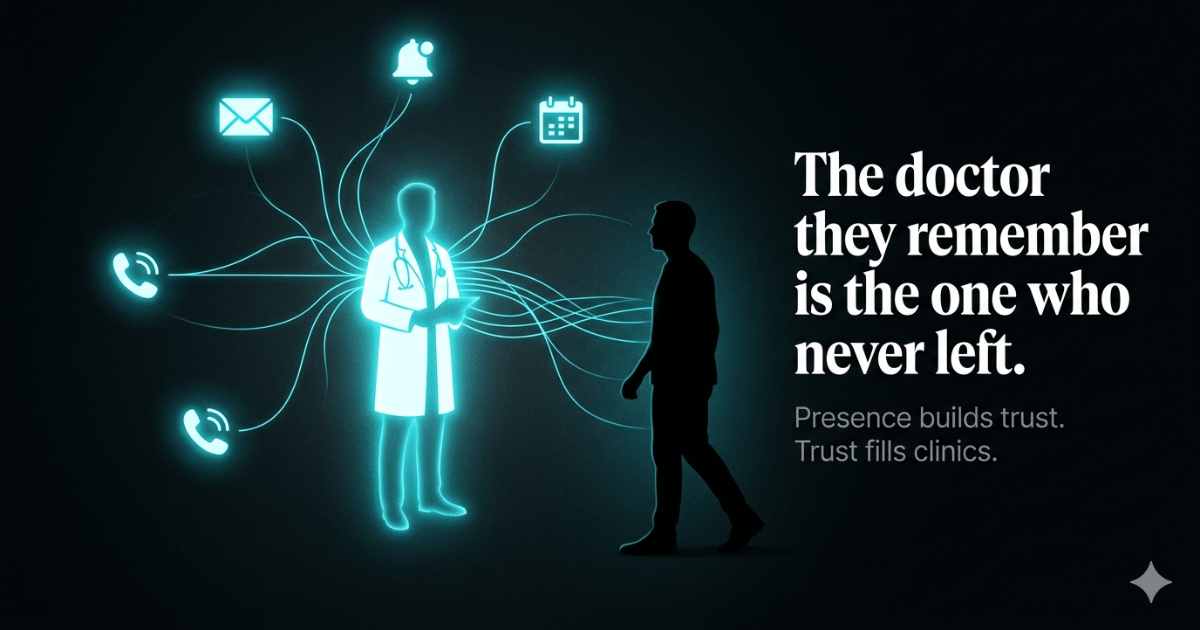
You spent 10 years in medical school. You've treated thousands of patients. Your results speak for themselves.
And yet — patients you treated six months ago are booking with someone else.
Not because that someone is better than you. Because that someone kept showing up. And you went quiet.
This is the most expensive invisible problem in modern medicine. And almost no doctor is talking about it.
Why Patients Don't Actually Come Back (The Real Reason)
Here's what most doctors assume: patients leave because of pricing, location, or a bad experience.
Sometimes that's true. But more often? It's simpler and more painful than that.
You disappeared.
The moment a patient walks out of your clinic, the clock starts. Other doctors — your competitors — are showing up in that patient's Instagram feed, inbox, and WhatsApp. Sharing insights. Sending value. Building rapport. Not just when the patient pays. Just like that. Consistently.
And you? Busy with the next appointment. Trusting that your expertise will bring them back.
It won't. Not on its own.
According to a 2024 Healthgrades study, 92% of healthcare seekers read a clinician's bio before booking an appointment — and 76% say a doctor's online reputation directly influenced which doctor they chose. Patients aren't just looking for qualifications. They're looking for presence, familiarity, and trust signals.
The doctor who shows up in their feed regularly becomes the familiar face. And familiar faces get the appointment.
The New Degree Patients Use to Choose Their Doctor
Let me give you a scenario.
You need a specialist. You have two options:
Doctor A: 20 years of experience. Brilliant. 200 Instagram followers. Last post — 8 months ago.
Doctor B: 15 years of experience. Good. 180,000 followers. Posts consistently. Reels getting shared. You've seen his content three times this week — once in your feed, once shared by a friend, once via email.
Who do you book?
Most people choose Doctor B. Not because he's better. Because he feels more present. More authoritative. More alive in their world.
This is the new credibility index. And it runs parallel to your medical degree now — whether you like it or not.
Followers. Consistency. Engagement. Reach. It's not replacing your expertise. It's amplifying it — or burying it. And right now, for most brilliant doctors, it's burying it.
Out of Sight. Out of Mind. But Then — Something Unexpected Happens.
Here's the mechanism silently killing patient retention.
The moment you stop showing up in their world — their feed, their inbox, their WhatsApp — you become a memory. A good one, hopefully. But a memory. And memories don't book appointments.
A patient consults you in January. Good experience. They intend to come back. But February passes. March passes. They see another doctor's reel three times. That doctor sends a newsletter with a genuinely useful tip. A friend shares their post. By April, your patient has a new doctor. Not because you failed them. Because someone else stayed in front of them.
Now flip it.
Imagine it's a Tuesday evening. Your patient has had a rough day. Stressed. Scrolling mindlessly. And then — an email lands. From you.
Not a "Happy Diwali from our clinic" blast that goes straight to promotions. Not a corporate template. A real, thoughtful, genuinely useful note. Something that makes them stop scrolling. Something that puts a smile on their face. Something that makes them think — "this doctor actually gets it."
Or imagine a friend forwards your reel. Patient watches it. Laughs. Learns something real. Thinks — "wait, I know this guy. I should go back to him."
That moment of recall? That smile? That's not marketing. That's presence.
For mental health coaches, therapists, and wellness experts — this is everything. The doctor who keeps throwing relevant value at their patients — not generic advice, but genuine moments of connection — builds something no ad can buy: loyalty. The kind where patients feel lucky to know you. Where they look forward to your emails. Where meeting you in person feels like meeting someone they've been following for years.
Yes. That actually happens. And it will never happen to a doctor who went quiet after the last appointment. 😄
Why Most Doctors Get This Wrong (And What They Try Instead)
When doctors realise they have a visibility problem, they usually try one of three things:
1. They hire a social media agency. The agency posts generic health tips with stock photos. Engagement is zero. Patients can tell it's not the doctor's real voice. Three months later, the retainer gets cancelled.
2. They try to do it themselves. They shoot a reel on a Sunday. Edit it. Get frustrated. Post it. Get 43 views. Give up. The cycle repeats every few months.
3. They run ads. Good for short-term appointments. Zero relationship building. The moment ads stop, so do the bookings. The patient still doesn't feel connected to the doctor as a person.
None of these solve the actual problem. The actual problem is not content. It's not ads. It's not agency management.
The actual problem is the absence of a system that keeps you consistently present — in your voice, with your expertise — without you having to produce it yourself.
The Cloning Engine: How Dr. Madhu Sudan Fixed This
In early 2026, Dr. Madhu Sudan — an Ayurveda and sexual health expert with 378,000 followers — was facing exactly this problem. Good content when he made it. Inconsistent posting. No real system. Five reels a month — some of them just brand collabs, not real trust signals.
We built him a Cloning Engine — a Done-For-You AI content system that took his expertise and turned it into daily content, in his voice and with his authority, without him ever stepping in front of a camera.
In just the first week of operations, two of those cloned reels crossed 50,000 views each. By April and May 2026, his total organic views crossed 400,000+.
Compare that to five reels a month — some brand collabs — to actual trust signals going out daily with real authority and real value. The consistency and engagement this started driving outperformed every other month in his entire social media journey. His reel views had been dropping due to inconsistency. The cloned reels reversed that completely — performing better than anything he had shot himself in the past year.
His consultations started filling from organic content. His Ayurvedic products started getting inbound enquiries without additional ad spend. Patients who had visited months ago started returning — because they kept seeing him in their feeds, shared by friends, arriving in their inboxes.
He didn't change his expertise. He didn't change his pricing. He didn't run more ads. He just stopped disappearing.
Seen enough? Watch how this works in practice.
Dr. Madhu fixed this without shooting a single video. 400,000+ organic views. More consultations. More returning patients.
Watch the Free Case Study →Frequently Asked Questions
Do doctors really need social media to get more patients?
In 2026, yes — but not in the way most people think. You don't need to go viral. You need to stay consistently present in the lives of patients who already know you. That consistent presence is what drives return visits, referrals, and organic growth. Social media is the most efficient infrastructure for that consistency.
How do I post consistently when I'm seeing 40 patients a day?
You don't post. Your system posts. The doctors winning at this aren't spending hours on content production. They have a mechanism that turns their existing knowledge into daily content — without their time. You ideate once. The system produces the rest.
What's the difference between a social media agency and getting cloned?
An agency creates generic content in someone else's voice. A clone creates content in your voice — your expertise, your tone, your perspective — at scale, without you producing it. Patients feel the difference instantly. One feels like a brand. The other feels like you.
What is AI content cloning for doctors — and is it just another cheap AI video trend?
No — and this distinction matters. The cheap AI-generated videos flooding your feed right now are built for eyeballs and quick sales. They're obvious. They're salesy. And they erode trust over time. AI content cloning for doctors is fundamentally different. It's a strategic system built around your persona — your trust signals, your expertise, your ICP, your communication style. Every piece of content is designed to build authority, not chase attention. To create goodwill and rapport. To make you genuinely omnipresent in the right patient's world — in a way that feels completely authentic to who you are.
Why are patients choosing other doctors over me even though I'm more qualified?
Because qualification is table stakes. Patients assume their doctor is qualified. What they're actually evaluating — consciously or not — is presence, familiarity, and trust. The doctor who shows up consistently in their world wins the perception game. And perception drives the booking decision.
How did Dr. Madhu get 400,000+ views on cloned content — and what did it do for his practice?
The cloned content was built on real patient pain points, delivered in Dr. Madhu's authentic voice, formatted for maximum organic reach. In the first week, two reels crossed 50,000 views each. But the real impact went beyond views. Consultation bookings started filling from organic content. His Ayurvedic products got inbound enquiries without additional ad spend. And unlike ads — where results stop when you stop paying — organic content compounds. Every reel that performs builds authority proof. Every share makes him more omnipresent. Ads give you appointments. Content gives you a practice that grows on its own.
The Bottom Line
Your patients aren't leaving because you're not good enough. They're leaving because someone else is more present.
In a world where 92% of patients read a doctor's bio before booking — and where a shared reel can trigger a return visit six months later — presence is no longer optional. It's clinical infrastructure.
The doctors who understand this in 2026 will build practices that grow without ads, without chasing patients, and without burning out. The doctors who don't will keep starting from zero every month.
You don't have to produce the content yourself. You just have to stop disappearing.